
Your claims history has a long memory.
What the CUE database records, how long it keeps it and how to check your own record.
Insurance
Imagine you are comparing car insurance quotes. You enter your details, confirm your mileage and answer a few questions about your driving history.
Then you reach the question about previous accidents and claims.
You remember a minor collision a few years ago. A damaged bumper, perhaps, or a scrape in a supermarket car park. You told your insurer about it at the time but decided to pay for the repairs yourself. No payout. No claim pursued. As far as you were concerned, that was the end of it.
Except it may not have been.
The Claims and Underwriting Exchange, known as CUE, is a UK insurance database of claims and reported incidents, including incidents that did not lead to a claim. Insurers that contribute to it can search it, and it can come up when you apply for cover.
It is one of the less visible parts of the insurance system. But knowing what CUE records, and how to check that it is accurate, can save confusion when buying or renewing insurance.
In short
- CUE is a shared UK database of claims and incidents reported to insurers, managed by the Motor Insurers’ Bureau (MIB).
- It can include accidents you reported to your insurer but did not claim for.
- For motor and home records, MIB says data is held for six years from the date the claim was closed, which can be well after the accident itself.
- You can ask MIB for your own record, usually free of charge.
- If something is wrong, take it up with the insurer that supplied it.
What is the CUE database?
The Claims and Underwriting Exchange (CUE) is a central database of motor, home, personal injury and industrial illness incidents reported to insurers. MIB’s privacy policy describes them as incidents that ‘may or may not have given rise to a claim’.
It is managed by the Motor Insurers’ Bureau (MIB) and the data supports underwriting accuracy and helps combat insurance fraud.
As an illustration, suppose a driver changes insurance companies every year. Without a shared record, a new insurer might have to rely largely on what the driver remembers about previous accidents. CUE allows participating insurers to check relevant records supplied by other insurers.
That does not mean CUE decides whether someone gets insurance or what they should pay. Those decisions belong to individual insurers, which use their own underwriting and pricing methods.
But the information held on CUE can feed into those decisions.
What information does the CUE database hold?
CUE holds more than a list of successful insurance claims.
What appears on a record depends on the incident. MIB says CUE includes details such as the claimant’s name and address and the status of the claim.
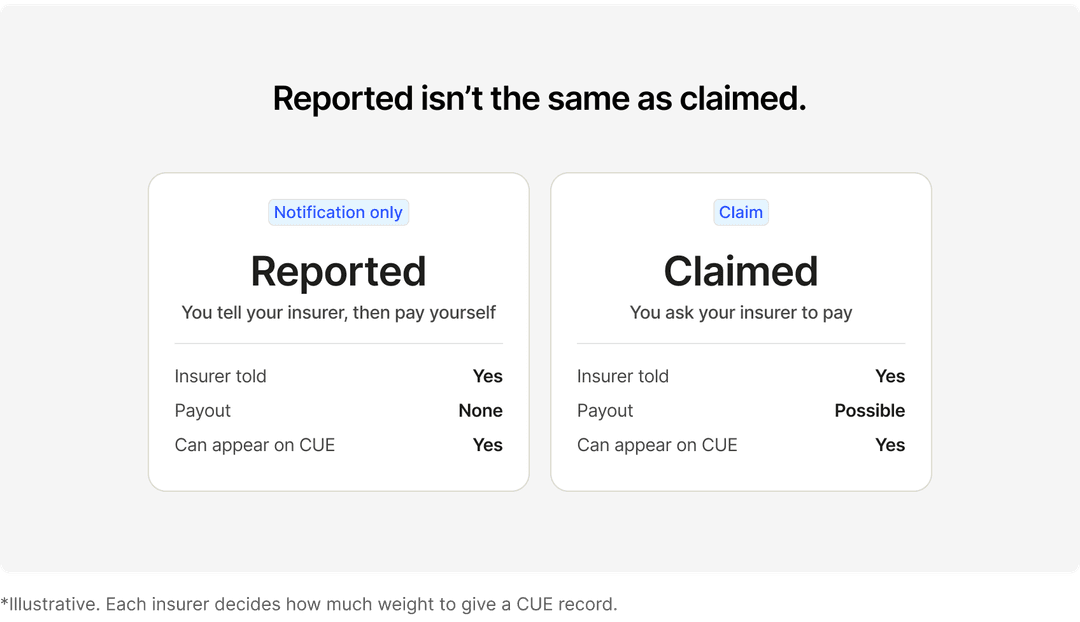
Crucially, the database can include incidents that were reported to an insurer but never became a claim. These are often called notification-only incidents, a term that appears in Financial Ombudsman Service decisions.
Consider a driver who reverses into a wall and damages their car. They telephone their insurer to report what happened, as their policy requires, but decide the repair bill is small enough to pay themselves.
The insurer can still record the incident on CUE.
A published Financial Ombudsman Service decision shows how this works in practice. It concerned one insurer’s notification-only entry on CUE and turned on its own facts. In it, MIB confirmed to the complainant that insurers may add a claim onto CUE even if the claim is not progressed and described this as ‘the correct use of CUE’. The Ombudsman did not uphold the complaint about the CUE entry.
A second decision is similar: an insurer recorded a ‘notification only’ incident on CUE after a non-fault accident, and the Ombudsman found it had acted fairly.
This distinction matters because an accident and an insurance claim are not the same thing. An accident is something that happened. A claim is a request for an insurer to provide compensation or another benefit under a policy. An insurer may want to know about the first even when the second never happens.
That does not mean every notification-only incident will increase a premium. In the same decision, the Ombudsman recorded the insurer’s advice that an accident that did not lead to a claim can, but does not always, have an impact on premiums.
How long do claims stay on the CUE database?
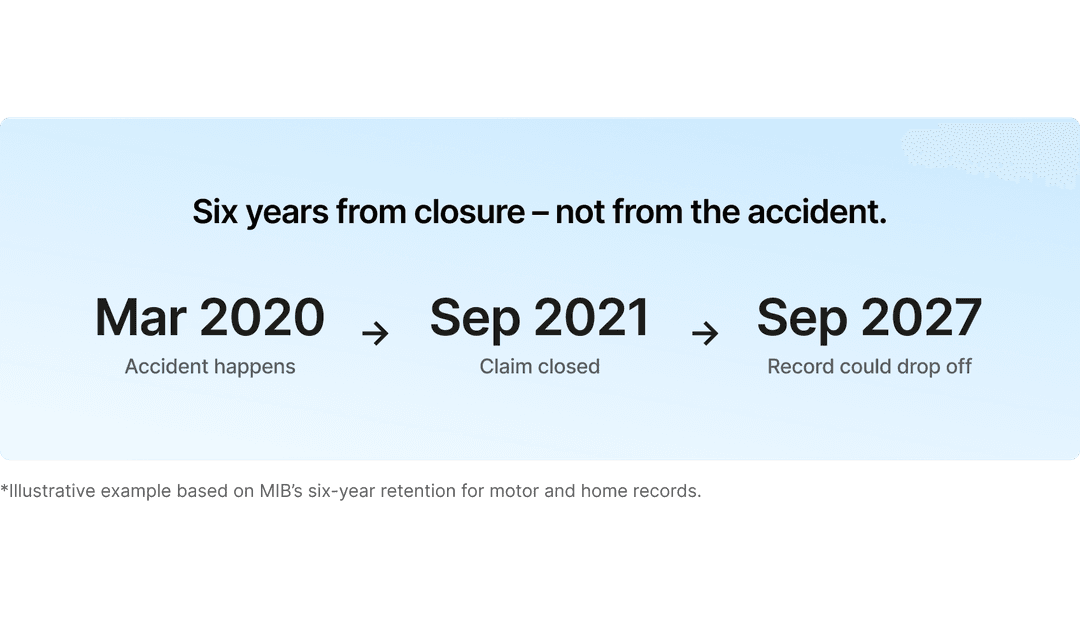
MIB’s data request page says CUE data is held for six years from the date the claim was closed. Its privacy notice confirms this for motor and home records.
The important detail is when the six years begin. It is not the date of the accident.
Suppose you had a collision in March 2020. Your insurer investigates, arranges repairs and deals with the other driver’s insurance company. The claim is eventually closed in September 2021.
Under that rule, the record could remain on CUE until September 2027. That is more than seven years after the original accident.
MIB’s published wording refers to the claim being closed. It does not spell out how that applies to a notification-only incident, where there may be no claim to close. If the exact date matters, ask MIB when you request your record.
Retention is also separate from what an application asks. Questions set their own period, so the wording matters: one that asks about the last five years covers five years, and one that asks about a longer period or all incidents covers that. Whether something is still on CUE does not change what the question asks.
How can you check your CUE claims history?
You can ask MIB for the information it holds about you on CUE. This is known as a data subject access request, or DSAR. Under UK data protection law (Article 15 of the UK GDPR), individuals have the right to see personal information held about them, subject to certain exemptions.
MIB’s requesting your data page has request forms for CUE. The forms are optional, but they show what MIB needs to identify you and find the right records. If you have trouble, you can email [email protected].
The request is usually free, although MIB reserves the right to charge a fee for requests that are unreasonable or excessive. MIB says it will respond within one month of receiving the request, which can be extended by a further two months for complex requests.
You can also contact your current or previous insurer and ask for details of your claims history. That can help if you are trying to clarify what happened to a specific claim.
When you receive your information, check more than the dates. Look at whether the incidents belong to you, whether the circumstances are recorded correctly, whether a claim is shown as settled or still open, and whether the claim type looks right.
An old accident appearing on CUE is not necessarily a problem.
An accident recorded incorrectly could be.
What happens if your CUE record is wrong?
Insurance databases depend on the information supplied to them. And information, however carefully collected, can contain mistakes.
A claim might be linked to the wrong person. An incident could be recorded under the wrong date. A settled claim might still appear as open. These details can matter because insurers may use claims information when assessing risk and calculating premiums.
MIB says that if data is incorrect, your first step is to contact the insurer or organisation that supplied it, because MIB only holds the data.
Explain what is wrong and provide supporting evidence where you can. That might include correspondence confirming a claim was settled, or documents showing that costs were recovered. Ask the insurer to update its information and to pass the correction to CUE.
If the insurer disagrees, ask for an explanation and consider making a formal complaint. You generally need to complain to the insurer first. For most complaints the business has up to eight weeks to respond, and you then have six months from its final response to bring the complaint to the Financial Ombudsman Service, which handles complaints about insurers. For concerns about how your personal information is handled, the Information Commissioner’s Office recommends raising the concern with the organisation first in most cases.
There is, however, a difference between inaccurate information and information you would simply prefer not to be there. MIB’s privacy notice says individuals have a right to rectification, particularly if data is factually inaccurate, and a right to erasure only in certain circumstances. It does not describe either right as a way to remove accurate data because it affects your premium.
The aim is to make sure the record reflects what actually happened.
Does the CUE database affect your car insurance price?
It can, indirectly.
Each insurer sets its prices using its own methods. In the Ombudsman decision mentioned above, the insurer advised that an accident that did not lead to a claim can have an impact on premiums. Comparison site Moneysupermarket adds that insurers may treat any kind of accident as a sign that you are likelier to claim again, and that prices usually change at renewal or when you buy a new policy rather than at the moment you claim. CUE can help an insurer check the claims information you give them.
How much weight an insurer gives a CUE record is a matter for that insurer. Different insurers use different pricing models, so the same claims history can produce different results depending on who is offering the cover.
One insurer may place considerable weight on a recent accident. Another may assess the circumstances differently. That is one reason two drivers with similar cars and driving histories can receive different quotes.
A CUE record is information an insurer may use. It is not a price in itself.
Can a non-fault accident increase your insurance premium?
Yes, it can, although it will not necessarily do so.
A non-fault accident is one where the driver was not responsible for what happened.
Imagine your car is parked outside your house when another driver hits it. You were not driving. You did nothing to cause the accident. The other driver’s insurer ultimately accepts responsibility.
It might seem reasonable to assume that the incident should have no effect on your future premiums.
But insurers do not assess risk solely by deciding who deserves blame. Comparison site Moneysupermarket says that even after a no-fault accident ‘you could pay more’, because insurers may treat any kind of accident as a sign that you are likelier to claim again.
Compare the Market says something similar: in many cases premiums will go up after a non-fault claim is declared, although it is hard to say by how much.
That does not make an increase inevitable. It means a non-fault incident is not necessarily invisible to insurers.
Is CUE the same as your no-claims discount?
No. Your CUE record and your no-claims discount are different things.
CUE is a record of claims and reported incidents. Your no-claims discount, sometimes called a no-claims bonus, is a discount an insurer may offer based on your record of claim-free insurance.
The two can overlap, but one does not automatically determine the other.
MIB’s description of CUE covers claims and incidents, not discounts. If a new insurer asks for proof of your no-claims discount, ask your previous insurer for it in writing.
Having no claims recorded for a period is not the same as having documentary proof of an accumulated discount.
What happens if you don’t declare an accident that’s on CUE?
If an insurer asks about previous accidents or claims, you are expected to answer accurately and take reasonable care not to misrepresent your history. That includes incidents where you did not make a claim, if the wording of the question covers them.
Suppose an insurer asks whether you have had any accidents, claims or losses in the last five years, regardless of fault or whether a claim was made. An incident from three years ago slips your mind because you paid for the repairs yourself, and you leave it out.
The insurer may later find it on CUE.
What happens next depends on the circumstances. The insurer might ask for an explanation, change the price or terms, or take other action. In more serious cases, inaccurate information can affect the validity of a policy or the handling of a claim.
But an omission does not automatically make a policy invalid. Under the Consumer Insurance (Disclosure and Representations) Act 2012, a consumer (an individual buying cover wholly or mainly for purposes unrelated to their trade, business or profession) must take reasonable care not to make a misrepresentation. The remedies apply to a ‘qualifying’ misrepresentation, one that made a difference to what the insurer would have done (section 4), and they depend on whether it was careless or deliberate or reckless (section 5).
Schedule 1 to the Act sets out the remedies. For a careless mistake, they depend on what the insurer would have done had it known. If it would not have offered cover at all, it may avoid the contract and refuse all claims but must return the premiums. If it would have offered cover on different terms, the policy is treated as if it had been made on those terms, if the insurer so requires. If it would have charged a higher premium, it may reduce claim payments in proportion. For a deliberate or reckless misrepresentation, the insurer may avoid the contract and refuse all claims and need not return the premiums unless keeping them would be unfair to the consumer.
The Act distinguishes between a careless mistake and a deliberate or reckless one, but a careless mistake can still have consequences.
If you realise you have made a mistake, your insurer, or a source of free advice such as Citizens Advice, can explain your options. It can also help not to guess what the insurer considers important: read the question carefully and answer what it actually asks.
Should you report an accident if you aren’t making a claim?
Your policy sets out when you must tell your insurer about an accident. In one published Ombudsman decision, for example, the policy required notice of any incident regardless of fault. Compare the Market also says you will still need to notify your insurer of an accident even if you don’t make a claim.
That can seem unnecessary when the damage is minor. But a collision that looks straightforward can become more complicated. Another driver might report additional damage. A passenger might raise an injury claim. Responsibility for the accident could be disputed.
Reporting the incident lets your insurer record what happened and respond if a claim emerges later.
That notification may also result in an entry on CUE. There is an understandable tension here: drivers may worry that reporting a minor accident will affect future insurance costs, even when they have no intention of claiming. But your policy may set consequences for not reporting an incident it requires you to report.
Your policy conditions will say what you need to report and when, and it helps to make clear whether you are only notifying the insurer or making a claim.
Who can access the CUE database?
CUE is not a public database that anyone can search.
MIB says CUE is used by insurers, brokers, solicitors and delegated authorities, and that organisations must share claims data in order to access it. In other words, participants contribute their own claims information and, in return, can see information supplied by others.
This helps explain why changing insurance companies does not mean starting with a blank claims history. It also explains why the information needs to be accurate. A mistake entered by one insurer can potentially be seen by another.
You can ask MIB for your own record, as explained above. But you cannot search CUE to look into someone else’s claims history.
Is CUE the same as the Motor Insurance Database?
No. They serve different purposes.
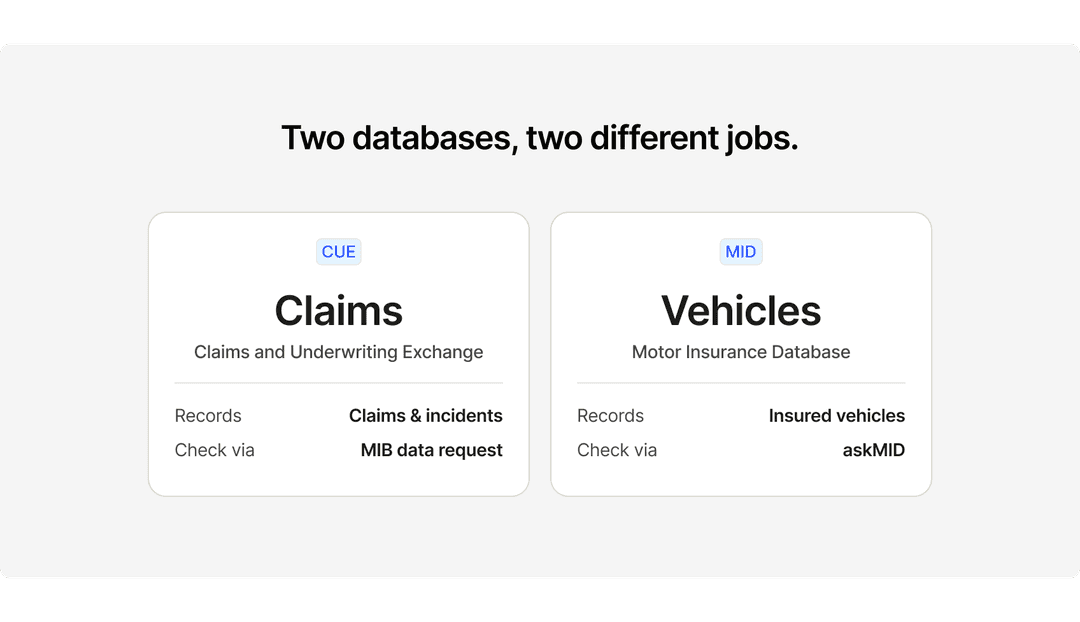
CUE records insurance claims and reported incidents. MIB’s Navigate FAQs describe the Motor Insurance Database (MID) as the central record of all insured vehicles in the UK.
You can check whether a particular vehicle is recorded as insured on askMID, which MIB’s Navigate FAQs point to.
The two are sometimes mentioned together because they support different parts of the insurance process. But they should not be confused.
If you want to check whether a vehicle is recorded as insured, CUE is not the relevant service. If you want to see what claims and incidents are recorded about you, it is.
Can checking CUE help you get cheaper car insurance?
Checking your CUE record will not automatically reduce your premium. It does not remove legitimate claims or reset your driving history.
What it can do is help make sure insurers are working with accurate information. If a claim has been recorded incorrectly, correcting it may change how an insurer assesses your history. Whether that produces a cheaper quote depends on the insurer and the nature of the correction.
Even when everything is accurate, knowing what is on your record makes applications easier. You are less likely to forget an incident, mix up dates or give inconsistent answers when changing provider.
It is also worth comparing quotes from different insurers, because they do not all price claims histories in the same way. The cheapest insurer for someone with no previous accidents may not be the cheapest for someone with a recent non-fault claim.
Checking that your information is correct, answering application questions carefully and comparing the cover as well as the premium all help you get a fair quote.
CUE may influence what insurers know about you. It does not decide which policy you should buy.
FAQs
What does CUE stand for in car insurance?
CUE stands for Claims and Underwriting Exchange. It is a UK database of motor, home, personal injury and industrial illness incidents reported to insurers, which supports underwriting accuracy and helps combat fraud.
Can I check my CUE record for free?
Usually, yes. You can request your personal CUE information from the Motor Insurers’ Bureau through a data subject access request, using the forms on MIB’s website. MIB says it will respond within one month of receiving the request, although that can be extended, and it reserves the right to charge a fee for requests that are unreasonable or excessive.
How long does an accident stay on the CUE database?
For motor and home records, MIB says CUE data is held for six years from the date the claim was closed. That is not necessarily six years from the date of the accident. MIB does not spell out how this applies to notification-only incidents.
Does CUE record accidents where no claim was made?
It can. MIB’s privacy policy describes CUE as holding incidents that “may or may not have given rise to a claim”, so paying for repairs yourself does not necessarily keep an accident off CUE.
Can a non-fault accident appear on CUE?
Yes. CUE records reported incidents, and a non-fault accident can be among them. Insurers may also take it into account when calculating premiums, although it does not automatically mean your insurance will cost more.
Can I remove a claim from the CUE database?
You can ask for inaccurate information to be corrected, and you may have a right to erasure in certain circumstances under data protection law. The privacy notice does not describe either right as a way to remove accurate data because it affects your premium. If you spot an error, contact the insurer or organisation that supplied the record.
Does CUE show my no-claims discount?
MIB’s description of CUE covers claims and incidents, not discounts. If a new insurer asks for proof of your no-claims discount, request it in writing from your previous insurer.