Similar insurance. Completely different cover.
The difference is often hiding in the excess, limits, exclusions and conditions – not the headline premium.
Insurance
Imagine two insurance quotes appear on your screen. One costs £420. The other, £405. Same type of insurance, similar-looking cover and only £15 between them.
It is tempting to choose the cheaper one and move on.
But an insurance quote is not simply a price. It reflects the cover being offered and the insurer’s approach to risk. Differences in excesses, policy limits, exclusions, optional benefits and claim conditions can mean two similar-looking quotes behave very differently when you actually need them.
That is why a meaningful insurance comparison starts with the cover – not the number in the largest type.
Why similar insurance quotes aren’t necessarily similar policies
Insurers do not all assess risk in exactly the same way. Each has its own underwriting and pricing approach, so the same information about a driver, car, home or policyholder can produce different premiums.
Factors such as driving history, vehicle characteristics, mileage, location, claims history and the cover selected can influence the price an insurer offers. As MoneyHelper points out, different insurers can charge different prices for the same driver.
Sometimes the results can seem surprisingly inconsistent. In one MoneySavingExpert forum discussion, a motorist reported quotes ranging from £275 to £365 for apparently identical pre-registered cars when different registration numbers were entered.
“I am currently considering purchasing a new car (pre-registered model). However when I run insurance quotes the prices vary for the same car when I put in different registration numbers (…). Quotes have varied from £275 to £365 for the exact same car but different registration (…)”
Legacy_user • Source
The explanations offered by forum contributors are anecdotal, so they should not be treated as evidence of how those particular insurers calculated the quotes. But the experience illustrates a wider point: insurance searches that look very similar can still produce different results.
The price is only one part of an insurance quote. The more revealing comparison is what each policy promises for that price.
The differences hiding behind the premium
Suppose two policies both offer £50,000 of contents cover. On the comparison screen, they may look interchangeable.
Look closer and they may not be.
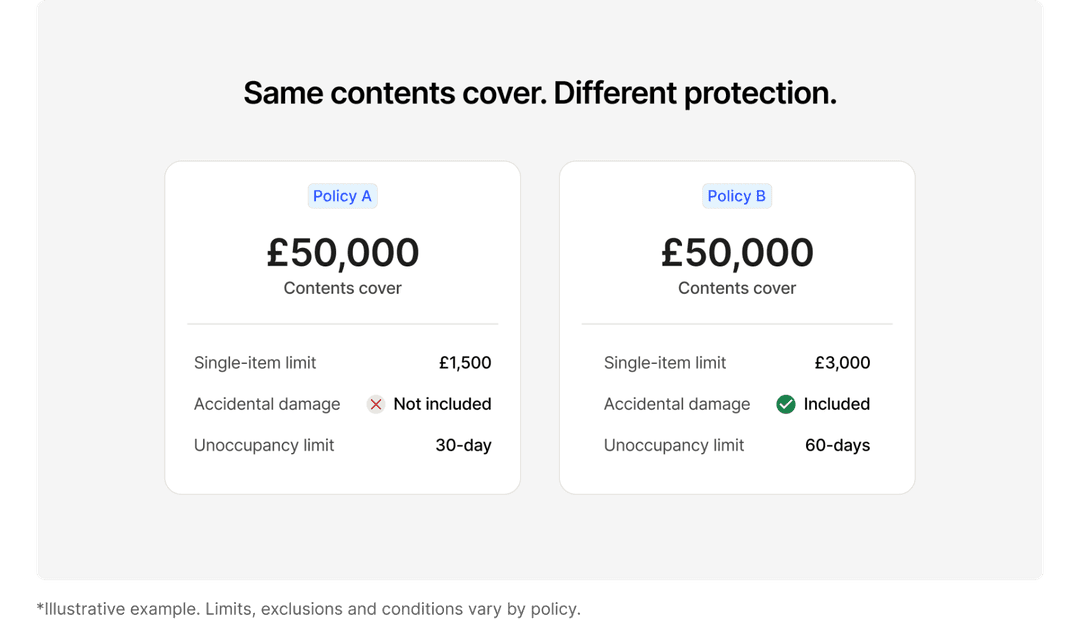
One could have lower limits for particular possessions. Another could carry a larger excess – the amount you must contribute towards a claim. Policies can also contain exclusions, sub-limits and conditions that affect whether a particular loss is covered and how much may be paid.
The Financial Ombudsman Service explains that policies can contain both overall limits and sub-limits, while an excess is the amount a policyholder has agreed to pay towards a claim.
The Financial Conduct Authority has previously warned that focusing on headline prices on comparison websites can distract consumers from factors including the level of cover, policy terms and excesses.
Small print, in other words, isn’t decorative legal scenery. It helps define what you are actually buying.
How to compare insurance quotes properly
A useful approach is surprisingly simple: temporarily ignore the premium.
Try covering up the price and comparing the protection first. Look at what is covered, the limits, the excess you would pay, important exclusions and which benefits cost extra.
For a more meaningful like-for-like comparison, check the level of cover, total excess, policy limits and sub-limits, exclusions and restrictions, optional benefits and relevant claim conditions.
Then look at the prices again.
This does not mean the cheapest policy is automatically inferior, or that paying more guarantees better protection. Different customers need different things from their cover.
It means that price becomes genuinely useful only once you understand what sits behind it.
Two insurance quotes can look almost identical because a comparison screen is very good at making prices easy to compare. Insurance itself is more complicated.
The important difference may not reveal itself when you buy the policy.
It may reveal itself when you claim.
FAQs
How can two insurance quotes for the same thing be different?
Because insurers don’t all judge risk in the same way. Each uses its own underwriting and pricing approach, so the same driver, car or home can produce different premiums. The policies themselves may also differ in their excesses, limits, exclusions and included benefits.
Can my insurance price go up even if I haven’t made a claim?
Yes. A claim-free year doesn’t guarantee that your renewal price will stay the same. Insurers consider a range of factors when setting premiums, so your price can change even when your own claims history hasn’t.
Does a cheaper insurance quote mean I’m getting less cover?
Not necessarily. A lower price doesn’t automatically mean poorer protection, just as a higher premium doesn’t guarantee better cover. The useful comparison is what sits behind the price: the excess, limits, exclusions, conditions and benefits included in each policy.
Is it better to choose a higher insurance excess?
It depends on the policy and what you could comfortably afford if you needed to claim. A higher voluntary excess can sometimes lower the premium, but it also increases the amount you’d have to contribute towards a claim.
What should I compare when looking at insurance quotes?
Start by putting the premiums to one side. Compare the level of cover, total excess, policy limits and sub-limits, exclusions, restrictions and optional benefits. Once you’re comparing broadly similar protection, the difference in price becomes much more meaningful.