

What is an IPID? Here’s how to read one.
An IPID is a short summary of what an insurance policy covers and what it leaves out. Here is how to read one in about five minutes.
Insurance
You have found a policy at a price you like, and you are one click from buying. Somewhere on the page is a link to something called an Insurance Product Information Document.
Most people skip it. That is a shame. It is the one document designed to tell you, in plain terms, what you are actually buying.
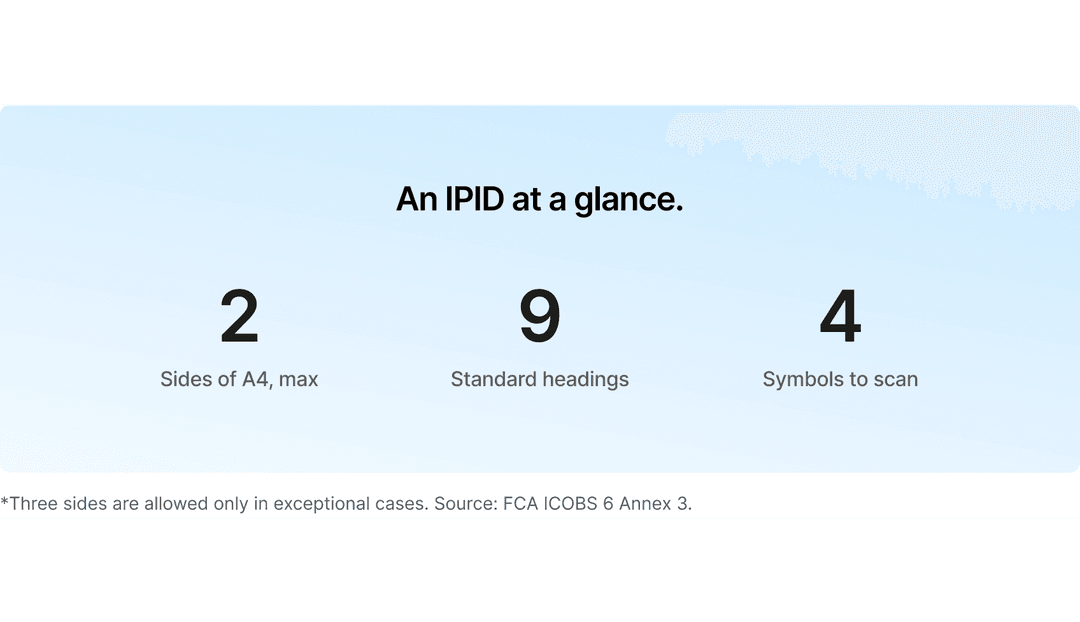
An IPID – short for Insurance Product Information Document – is a standardised summary of a general insurance policy. Under FCA rules, it should be two sides of A4 at most (three in exceptional cases). The insurer must write it in plain language, and you should get it before you buy.
Think of it as the back of the box, written by someone who has to be brief.
What is an IPID?
An IPID is a standard summary of a general insurance policy. It tells you what the policy covers, what it does not, and the main conditions attached. The insurer or product provider writes it, and it follows the same layout whichever company produced it.
That sameness is the point. Compare two home, travel, motor or pet policies and the same questions appear in the same order. You can put the documents side by side and see where they differ.
IPIDs apply to most general insurance, such as home, contents, motor, travel and pet cover. Pure protection contracts such as life insurance do not need one, because they sit under different rules. The requirement comes from the FCA’s insurance conduct rules, ICOBS 6.
People often search for ‘IPID insurance’, but an IPID is not a type of insurance. It is the document that comes with a policy.
That said, an IPID is a summary, not the contract. The IPID says so itself, and we come back to that below.
When should you get an IPID?
Before you buy. The FCA says firms must give you policy information ‘in good time’. That means before the policy is concluded, including when you renew. A firm must provide an IPID for each policy, on paper or another durable medium (a PDF you can save, for example). The details are in ICOBS 6.1.
The FCA regulates the format too. Under ICOBS 6 Annex 3, an IPID must be short and stand-alone. It runs to two sides of A4 (three in exceptional cases), and the firm must write it in plain language without jargon.
So, if an IPID reads like a legal contract, it is not doing its job. And if you cannot find one before you pay, ask the insurer or broker for it.
How to read an IPID, section by section
Every IPID follows the same running order. The FCA sets it out in ICOBS 6 Annex 3. It opens with the name of the company that designed the product, its regulatory status and its FCA reference number. A short reminder follows: the full terms are in other documents, usually the policy wording.
Then come nine headings, always in this order:
Nine headings, always in the same order.
| Section | What it tells you | What to check |
|---|---|---|
| What is this type of insurance? | The kind of cover and what it is broadly for | That it is the type of product you meant to buy |
| What is insured? | The main risks covered and the amounts insured | Whether your main concerns are listed, and whether the limits are high enough |
| What is not insured? | The main risks that are not covered | Anything you were counting on appearing here |
| Are there any restrictions on cover? | The main exclusions and limits on what is paid | Whether any apply to your home, car, or trip |
| Where am I covered? | Where the cover applies | Your location or destination, which matters most for travel |
| What are my obligations? | What you must tell the insurer, and what you must do during the policy and after a loss | What you must disclose, and the steps to take if you claim |
| When and how do I pay? | How and how often you pay | That the payment terms suit you |
| When does the cover start and end? | The start date, end date and length of the policy | That the dates match what you need |
| How do I cancel the contract? | How to end the policy | The process, and whether leaving early costs you anything |
The first three sections are worth thirty seconds each. The middle three, covering restrictions, location and your obligations, are where it pays to slow down.
What do the symbols on an IPID mean?
Four symbols do most of the work. They sit beside individual items, so you can scan a page and see the shape of the cover.
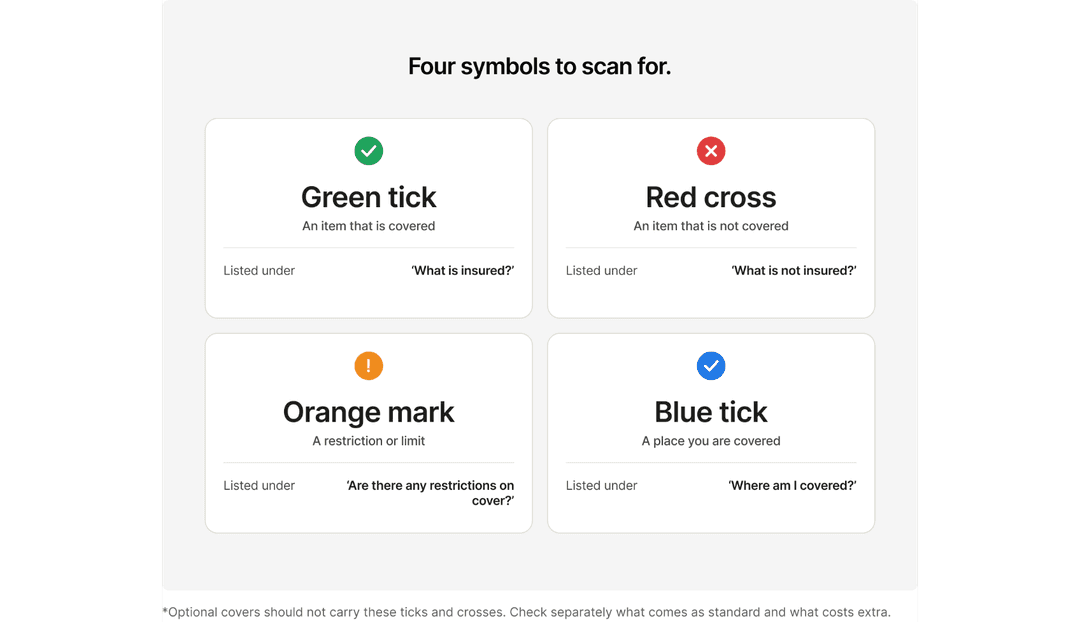
Each section heading also carries its own small icon, as the FCA’s icon rules require. The FCA also says optional covers should not carry these ticks and crosses. Check separately what comes as standard and what costs extra.
What an IPID doesn’t tell you
An IPID is a summary. The FCA requires it to say that full pre-contract and contract information is in other documents. Full definitions, every exclusion and the precise wording of conditions sit in the policy documents. Read those before you rely on a tick.
An IPID is also not a price comparison. It explains how and when you pay. It does not say whether this policy is cheaper or better value than another. For that, look at the excess, limits and exclusions behind each quote, which we cover in Similar insurance. Completely different cover.
A green tick tells you a risk is covered in principle. The policy wording decides whether a particular claim is paid, and how much.
A five-minute check before you buy
You do not need to read every word. This order gets you most of the value:
Your five-minute check
- Match the cover to your list. Under ‘What is insured?’, look for the things you most want protected, and check the amounts are enough.
- Read the gaps. Under ‘What is not insured?’ and the restrictions section, look for anything that applies to you.
- Check where you are covered. Make sure your home address, vehicle use or destination is somewhere the policy covers.
- Know your obligations. See what you must tell the insurer and what you must do if something goes wrong. Failing to follow the conditions can affect a claim.
- Confirm the details, then open the wording. Check the dates, payment terms and cancellation process. Then search the policy wording for the three or four things that matter most to you.
None of this takes long, and it is far easier before you have paid than after you have claimed.
“The document that tells you what a policy leaves out is only useful if you read it while you still have a choice.”
FAQs
What does IPID stand for?
Insurance Product Information Document. It is a standardised summary of a general insurance policy.
Is IPID insurance a type of insurance?
No. IPID stands for Insurance Product Information Document. It is the summary that comes with an insurance policy, not a product you buy.
Is an IPID the same as my policy wording?
No. The IPID is a short summary of the main cover, exclusions and conditions. The policy wording holds the full terms, definitions and exclusions. A claim is judged against the wording in the policy.
Will I get an IPID?
For most general insurance, yes. FCA rules require a firm to provide an IPID for each policy. You should get it in good time before the policy is concluded, including at renewal. Pure protection contracts, such as life insurance, are outside that rule.
Is there an IPID for life insurance?
Not under the same rule. The IPID requirement does not apply to pure protection contracts. Different requirements cover them.
Where can I find my IPID?
The insurer or broker usually puts it on its website and sends it with your documents before you buy. If you cannot find it before paying, ask for it.
Can an IPID be longer than two pages?
Rarely. The FCA limits it to two sides of A4. It allows three in exceptional cases that the firm must be able to justify.