

Claim rejected? You can still fight it.
Why insurers say no to home claims, what to do next and how to complain if they got it wrong.
Insurance
The letter arrives, and the answer is no.
You may have paid your premium for years. You may be in the middle of a repair, with a ceiling down or a pipe burst, and now the insurer says it won’t pay.
It is tempting to give up, or to shout at the claims handler, but neither helps much. What does help is knowing why a home insurance claim is declined, what the insurer has to tell you, and how to challenge the decision properly.
“A rejection is the insurer’s decision. It isn’t the last word.”
Why do insurers reject home insurance claims?
Most rejections come down to a handful of reasons. Your letter should say which one applies to you. If it does not, asking for it is your first step.
- The cause isn’t covered. Policies cover only specific events, and many exclude wear and tear, gradual damage and faulty workmanship. Which? has reported on cases where insurers cited the last two.
- You were underinsured. If your sum insured is lower than the real cost of rebuilding or replacing, the insurer may pay only part of the claim.
- Something wasn’t disclosed, or was wrong. An inaccurate answer on your application, or a material change in your circumstances that you did not mention, can lead to a claim being declined or reduced in value.
- A policy condition wasn’t met. Examples are leaving the home empty for a long stretch, or not having the security the policy asks for. Check the wording, because conditions vary.
- There isn’t enough evidence. Insurers expect proof of the loss: photos, receipts, reports and repair estimates.
- The claim came too late, or premiums weren’t paid.
What happens if you are underinsured? A worked example
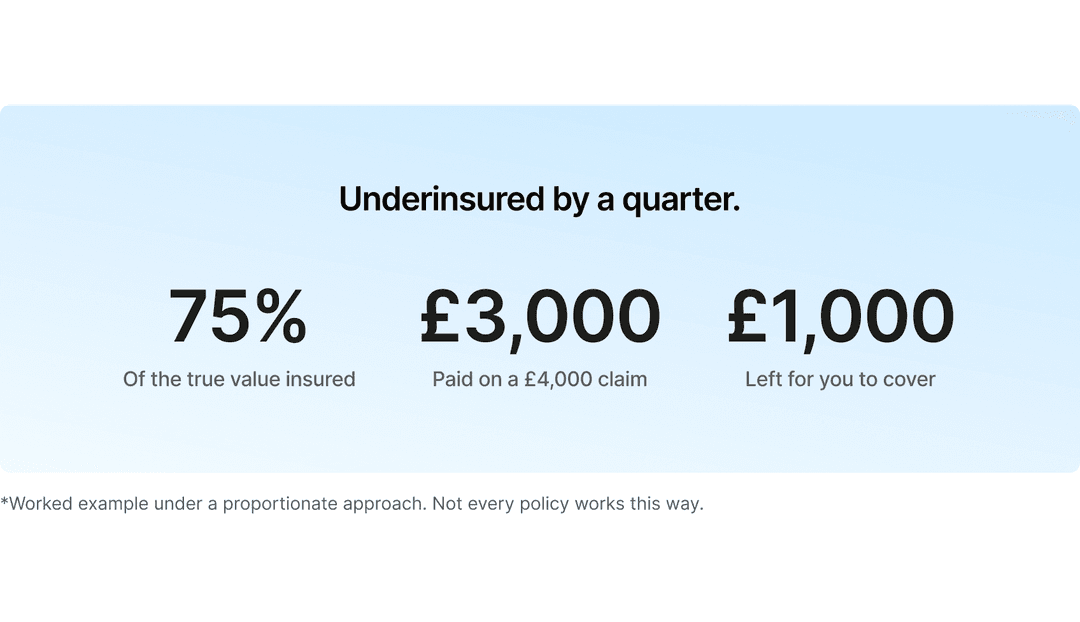
Say your contents are really worth £20,000, but you insured them for £15,000. That is only 75% of the true value.
A burglar then takes a £4,000 laptop and camera. Under a proportionate approach, the insurer pays 75% of the claim, which is £3,000, and the other £1,000 is yours to cover.
Not every policy works this way, so read yours. But it shows why an insurer can pay a claim and still leave you short.
How often are home insurance claims rejected?
Nobody can give you one reliable number. The picture is clear enough, though: most claims are paid, and a sizeable minority are not paid in full.
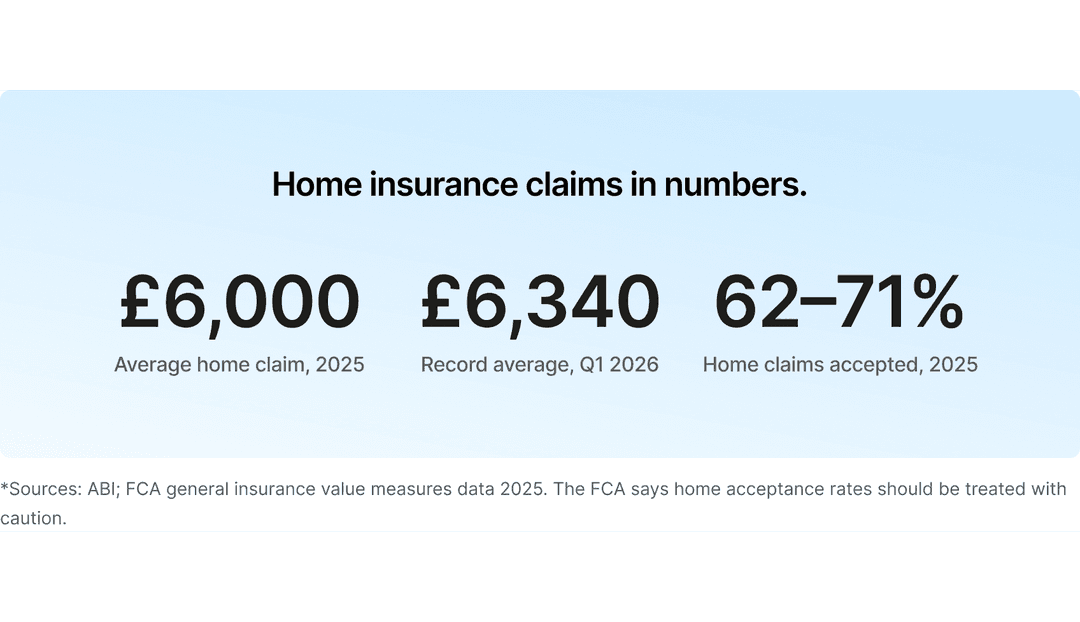
First, the scale. The Association of British Insurers (ABI) reports that insurers paid out almost £3.4 billion in settlement of more than 560,000 home insurance claims during 2025. The average claim was about £6,000, up 15% on the year before. In the first three months of 2026, the average hit a record £6,340, up 20% on the same period a year earlier.
Now the rejections. The FCA’s latest data puts the claims acceptance rate for home insurance at 62% to 71% in 2025. For comparison, travel was 83% to 86% and motor was 99%. Acceptance is the share of registered claims that aren’t rejected, so those home figures would mean roughly 29% to 38% of claims weren’t accepted.
Treat that range with care. The FCA says firms report home claims acceptance in different ways, so the rates should be treated with caution. It has set up an industry working group on the problem.
What to do if your home insurance claim is rejected: the first week
A home insurance claim declined in full or in part can still be challenged. Avoid replying in anger, and keep everything connected with the claim. Take these steps in order.
- Get the reason in writing. If the letter is vague, ask the insurer to confirm the exact reason and which part of your policy wording it relies on.
- Read your policy. Compare the reason with your policy schedule and wording. Look at the cover, exclusions, limits, excess and conditions.
- Gather your evidence. Collect photos, videos, receipts, repair estimates and all correspondence. Keep damaged items until the claim is settled, and take sensible steps to stop things getting worse, keeping receipts.
- Keep a note of every call. Write down the date, who you spoke to, what was said and any reference number. The Financial Ombudsman asks complainants to keep this kind of record.
- Ask for a review. Write to the insurer, explain why you think the decision is wrong and attach your evidence. Ask for a copy of any report it relied on.
If your claim involves a surveyor or loss adjuster, remember that they work for the insurer. A loss assessor works for you, but usually charges a fee, so check the cost before you hire one.
How do you complain about a rejected home insurance claim?
The route is the same for most complaints. Two deadlines matter, so note both.
- Complain to your insurer first. Say what you want, such as a review or payment, and attach your evidence. Ask for its final response in writing.
- Give it up to eight weeks. For most complaints, a business has up to eight weeks to respond. If you have not received a final response in that time, you can go straight to the Financial Ombudsman.
- Go to the Ombudsman within six months. You have six months from the date on the insurer’s final response. Once that period has passed, the Ombudsman is usually unable to consider the complaint, other than in limited circumstances such as serious ill health or a bereavement.
The Ombudsman’s service is free, and you don’t need a lawyer or claims management company. If you accept its findings, the insurer has to follow them.
A template you can adapt
Subject: Complaint about the rejection of my claim, reference [claim number]
Dear [insurer name],
I am writing to complain about your decision of [date] to reject my claim for [what happened and when, e.g. water damage to my kitchen ceiling on 3 March]. My policy number is [number].
Your letter says the claim was rejected because [reason in their words]. I disagree because [your reasons, and the policy section you rely on].
I enclose [list your evidence, e.g. photos, receipts, repair estimate, correspondence].
Please [your outcome, e.g. reconsider the claim and pay it, or send me a copy of the report you relied on].
Please send me your final response in writing. If I remain dissatisfied, I will refer my complaint to the Financial Ombudsman Service.
Yours sincerely, [your name, address and contact details]
Keep a copy, and note the date you sent it.
Will the Ombudsman overturn a declined home insurance claim?
Sometimes. Each quarter, the Financial Ombudsman publishes the number of complaints it receives about every product, along with the share it decides in the customer’s favour, which it calls the uphold rate.
Here are the latest two quarters for home insurance.
Home insurance complaints to the Ombudsman.
| Product | Period | New complaints | Upheld |
|---|---|---|---|
| Buildings | July to September 2026 | 1,767 | 36% |
| Buildings | April to June 2026 | 1,766 | 33% |
| Contents | July to September 2026 | 452 | 24% |
| Contents | April to June 2026 | 472 | 24% |
In the latest quarter, roughly one in three buildings complaints, and about one in four contents complaints, ended in the customer’s favour. These numbers include every complaint about the products, not only rejected claims, so treat them as a guide rather than a forecast for your own case.
These figures are taken from the Ombudsman’s quarterly complaints data, published on 22 October 2026. A decision can go either way, and your evidence and the policy wording are what count.
How can you lower the risk of a rejection next time?
You can’t remove the risk, but you can shrink it.
- Insure for the right amount. Check that your buildings cover reflects the cost of rebuilding, and that your contents cover reflects what it would cost to replace everything. This is the best defence against being underinsured.
- Answer questions accurately. Give full and correct answers when you buy or renew, and tell your insurer promptly about any change, such as building work, a new tenant or an extended period away from the property.
- Read the conditions. Look at what the policy says about leaving the home empty, security and high-value items.
- Keep your records. Store receipts, photos and valuations for important items somewhere safe, ideally off-site or in the cloud.
- Report promptly. Tell your insurer as soon as something goes wrong, and ask what it needs from you.
It also helps to compare policies on what they cover, not just on price. Our guide to why two quotes that look the same can cover different things explains how.
FAQs
What to do if home insurance claim is rejected: can I appeal?
Yes. Ask the insurer to review the decision, then make a formal complaint if it won’t change its mind. If you remain unhappy with the outcome, or the insurer has not sent a final response within eight weeks, you can take the complaint to the Financial Ombudsman Service.
How long does the insurer have to answer my complaint?
For most complaints, a business has up to eight weeks to give a final response. After that, you can take the complaint to the Ombudsman.
How long do I have to go to the Ombudsman?
You have six months from the date on the insurer’s final response. Once that period has passed, the Ombudsman is usually unable to consider the complaint, other than in limited circumstances such as serious ill health or a bereavement.
Does it cost anything to complain to the Ombudsman?
No. The service is free, and you don’t need a lawyer or claims management company.
Why was only part of my claim paid?
The usual causes are being underinsured, the excess you agreed, policy limits and exclusions. Ask the insurer for a breakdown showing how it calculated the payment.
How often does the Ombudsman side with the customer?
Between July and September 2026, the Ombudsman decided 36% of buildings insurance complaints and 24% of contents insurance complaints in the customer’s favour. Those numbers include every complaint about the products, not only rejected claims.
What if my claim was rejected because I didn’t tell the insurer something?
An insurer can decline or reduce a claim when the details given at the start were wrong, or when a significant change was never disclosed. Ask exactly what the insurer says you missed, check your policy wording and keep your own records of what you were asked.
Sources
- ABI: Adverse weather pushes property insurance payouts to £6.1 billion in 2025
- ABI: Home insurers pay out £846 million to support households
- FCA: General insurance value measures data 2025
- Financial Ombudsman Service: Quarterly complaints data, Q2 2026/27
- Financial Ombudsman Service: Quarterly complaints data, Q1 2026/27
- Financial Ombudsman Service: How to complain
- Financial Ombudsman Service: Time limits
- Which?: Home insurers are declining too many claims