Probate costs: the court fee is the easy part.
For most estates the court fee is £526. Professional fees are where the bill really grows.
Finance
Search for the cost of probate and you will find three different court fees within minutes. One page says £300. Another says £526. An older article says £215. A solicitor's page says its service starts from £3,300 plus VAT, and a money guide says the whole thing could be anywhere from 1% to 5% of the estate.
Everyone is quoting a number. Hardly anyone says which number is current, or what it covers.
That is partly because ‘probate cost’ is three separate costs under one name: the fee the court charges, the fees professionals charge, and the smaller bills that turn up along the way. The first is fixed by the government. The other two depend on who you hire, how complicated the estate is and how the firm prices its work.
This guide separates them, shows where each figure comes from and says when it was last checked.
How much does probate cost? The short answer
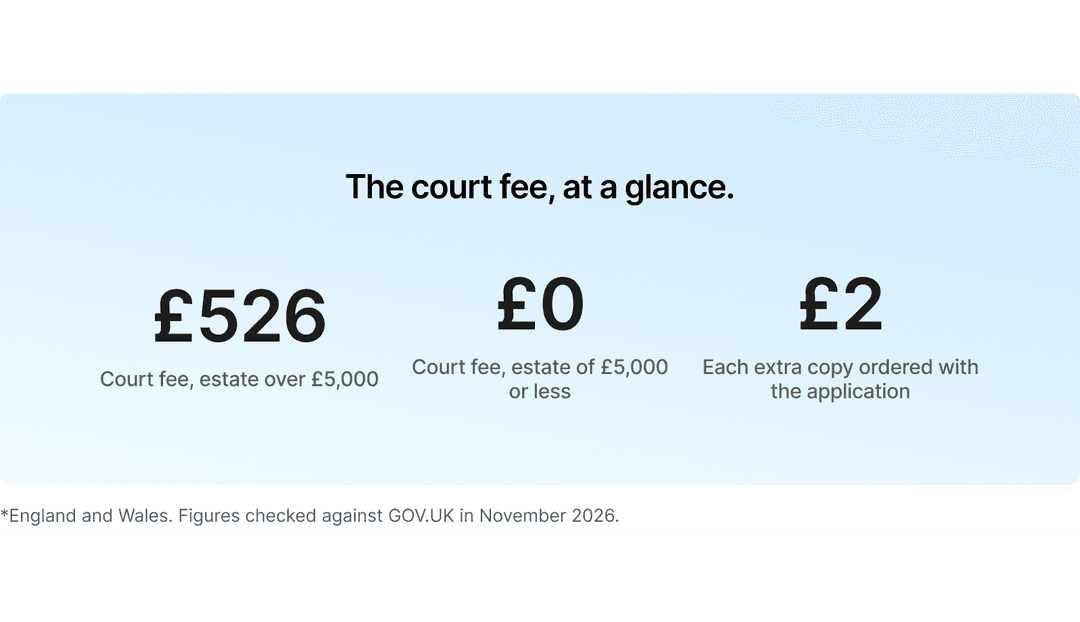
For most estates in England and Wales, the unavoidable cost is the £526 court fee. Everything else depends on whether you do the work yourself, pay for a grant only, or hand over the whole estate.
What probate costs.
| Cost | Typical figure | Who sets it | Source |
|---|---|---|---|
| Court application fee, estate over £5,000 | £526 | Government | GOV.UK |
| Court application fee, estate of £5,000 or less | No fee | Government | GOV.UK |
| Extra official copies ordered with the application | £2 each | Government | GOV.UK |
| Extra copies ordered later | £16 each | Government | GOV.UK |
| Grant-only service from a firm | £500–£2,000, depending on the type of firm | The provider | MoneyHelper |
| Full estate administration, percentage fee | 1%–5% of the estate, plus VAT | The provider | MoneyHelper |
| Full estate administration, fixed fee | From £3,300 plus VAT (one firm's starting price) | The provider | Attwells Solicitors |
| Notices to creditors | From £96.55 plus VAT; local newspaper placement £240 plus VAT | Newspapers and The Gazette | The Gazette |
These costs are usually paid out of the estate rather than from your own pocket, according to Age UK. Inheritance tax, if any is due, is a separate bill that these figures do not include. What you owe depends on things such as the residence nil-rate band.
The court fee: £526, and why you may still see £300
The probate application fee, paid to the probate registry when you apply for probate, is now £526 for any estate worth more than £5,000. The fee is flat, whatever the size of the estate and whether you apply yourself or through a solicitor.
The figure changed on 13 July 2026, when it rose from £300. The increase comes from the Court and Tribunal Fees (Miscellaneous Amendments) Order 2026 (SI 2026/642), which was due to start on 6 July. A second order (SI 2026/665) moved the start to 13 July. The £300 fee had applied since 1 May 2024, according to a House of Lords written answer. GOV.UK shows the new fee, and GLP Solicitors and Age UK's August 2026 factsheet give the same date.
That is why older pages still disagree. Anything written before July uses the old number.
How the probate fee has changed.
| Period | Probate application fee | Source |
|---|---|---|
| October 2019 | £215 if you applied yourself, £155 through a solicitor | Which? |
| 26 January 2022 to 30 April 2024 | £273 for all applicants | Legislation.gov.uk |
| 1 May 2024 to 12 July 2026 | £300 | House of Lords written answer |
| From 13 July 2026 | £526 | GOV.UK |
Two smaller changes are worth knowing about. Extra copies of the grant ordered with the application now cost £2 each, down from £16. Copies ordered after the application is submitted stay at £16 each.
If money is tight, you may be able to get help with fees. GOV.UK says the full fee is paid up front when you apply online and refunded if your help-with-fees application succeeds. Copies cannot be covered.
What professionals charge, and why quotes look so different
Professional fees vary because firms price in three different ways, so two quotes for the same estate can differ by thousands of pounds.
MoneyHelper explains that some firms charge an hourly rate, some charge a percentage of the estate and some charge a fixed fee. It says fixed-fee services are ‘likely to be significantly cheaper’, and that specialist probate firms cost less than solicitors, who cost less than banks.
The type of help matters as much as the pricing model.
- Grant-only probate. The firm obtains the grant and you handle the rest of the estate. MoneyHelper says to expect £500–£2,000 depending on the type of firm, and that asking for this option ‘will save you thousands’ compared with full administration.
- Full estate administration. The firm takes over administering the estate: valuing assets and liabilities at the date of death, paying debts and passing on what is left. This is where percentage and hourly fees grow, particularly for complex estates. One firm, Attwells Solicitors, says its fixed fee starts from £3,300 plus VAT, and from £1,200 plus VAT for grant-only.
Percentage fees deserve a closer look, because a percentage of the estate scales with its value rather than with the work. MoneyHelper puts them at 1% to 5% of the estate's value, plus VAT at 20% and disbursements.
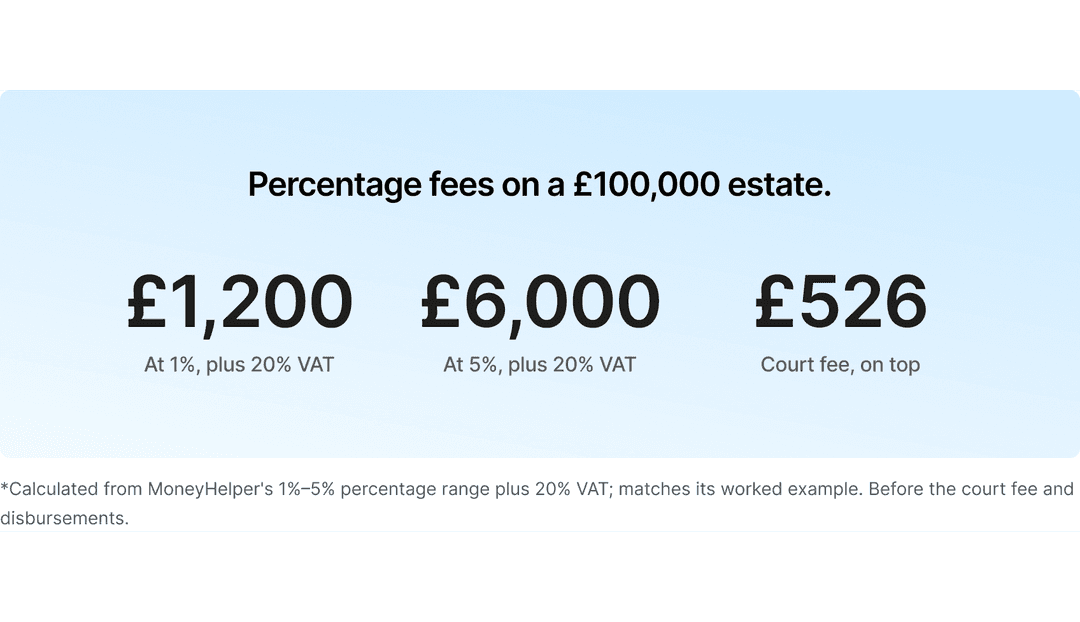
These are the ends of a published range, not typical quotes, and MoneyHelper does not cite a source for the range itself.
The lesson is simple. The same estate can cost £1,200 or £6,000 to administer, depending on who does the work and how they bill.
The smaller costs people forget
A few smaller costs can appear on top of the court fee and professional fees, and most depend on what is in the estate.
- Notices to creditors. Executors usually put a notice in The Gazette and a local paper to find any debts they don't know about. The Gazette's 2026 price list shows £96.55 plus VAT for a standard deceased-estates notice, and £240 plus VAT to have it placed in a local newspaper. MoneySavingExpert says the cost can be claimed back from the estate.
- Valuations and sale costs. If there is a property or other asset to value or sell, MoneyHelper lists valuation fees, estate agent, conveyancing and Land Registry fees, and stockbroker or registrar fees. None of its sources give typical prices, so ask for estimates.
- VAT on professional fees. Most specialists add VAT at 20% to their fees, Age UK notes, which can raise a bill by more than people expect.
- Paying before you have the money. Inheritance tax and probate fees may fall due before the estate's money is released. Banks also usually need the grant before they release larger balances from the deceased's bank accounts. Age UK says a loan is sometimes needed and is repaid from the estate once the grant arrives.
DIY probate, grant-only or full estate administration: which is worth paying for?
Doing it yourself is the cheapest route on paper, but it is the one where you carry all the responsibility. The right choice depends on how complicated the estate is and how much time you have.
Three routes compared.
| Route | What you do | What you pay on top of the court fee | Often suits |
|---|---|---|---|
| DIY | Apply for the grant and administer the estate yourself | Copies and notices only | Simple estates and confident executors |
| Grant-only | A firm obtains the grant; you handle the rest | £500–£2,000, depending on the type of firm (MoneyHelper) | Executors who can manage the rest but want the application done properly |
| Full administration | A firm handles the grant and the whole estate | Percentage, hourly or fixed fee, plus VAT and disbursements | Complex estates, property sales or executors short of time |
Look hard at the first row. Age UK says doing it yourself ‘can reduce costs’, but you take on ‘a lot of responsibility’. Executors are legally responsible for paying every valid claim, including tax.
How to compare probate quotes properly
A useful trick is to ignore the headline fee at first and compare what each quote actually includes. A £1,500 quote and a £3,500 quote may not be selling the same thing.
MoneyHelper's advice is to compare quotes and use competing ones to negotiate. The Solicitors Regulation Authority's transparency rules require regulated firms offering uncontested probate to publish their prices, say whether VAT is included and what the price covers, and give staff qualifications and typical timescales. The SRA last updated that guidance on 30 September 2024. Age UK also says regulated firms must publish prices.
Before you choose, ask each firm
- Is this grant-only probate or full probate and estate administration?
- Is the fee fixed, hourly or a percentage of the estate?
- Is VAT included?
- Does the price include the court fee and other disbursements, and what are the estimates for them?
- Which services carry an additional cost, such as selling a property or dealing with tax?
- When is payment due, and is it in stages?
- Is this a firm quote or a ballpark figure that could rise?
- Who will do the work, and what are their qualifications?
Ask for the answers in writing, then compare like with like. Only then does the price tell you anything.
How to keep probate costs down
The biggest savings come from picking the right level of help and comparing quotes before you commit.
- Check whether you need probate at all. Age UK says probate may not be needed if the estate is worth less than £5,000, and the court fee is waived at that level. Banks set their own limits for releasing money without a grant, so ask them.
- Ask for grant-only. MoneyHelper says this option can save thousands compared with full administration, if you can handle the rest yourself.
- Get several quotes, then negotiate. MoneyHelper suggests using competing quotes to bargain with your preferred provider.
- Order copies with the application. Extra copies cost £2 each at that point and £16 each afterwards.
- Think twice before naming a bank as executor. MoneyHelper says bank fees can reach tens of thousands of pounds in some estates.
- Apply for help with fees if you qualify. GOV.UK says it is open to people on a low income or certain benefits.
“None of this needs special knowledge. It needs a few questions asked early, before anyone has started billing.”
FAQs
How much does probate cost in 2026?
The court fee is £526 for estates over £5,000 in England and Wales, and there is no fee at £5,000 or less. Professional fees are extra: MoneyHelper says to expect £500–£2,000 for a grant-only service, and percentage fees for full administration usually run from 1% to 5% of the estate plus VAT.
Is there a probate fee on a small estate?
No. GOV.UK says there is no application fee for estates valued at £5,000 or less, although a second application costs £22 regardless of the estate's value.
Why do some websites still say the probate fee is £300?
Because £300 was the fee from 1 May 2024 until 12 July 2026. Pages written before the change have not always been updated.
Does the probate fee depend on the size of the estate?
No. Above £5,000 it is a single flat fee of £526, and below that there is nothing to pay. A sliding scale based on estate value was proposed in 2019 but scrapped before it took effect, as Which? reported at the time.
Can I apply for probate myself?
Yes. Age UK says doing it yourself can cut costs, but you take on a lot: you are legally responsible for paying valid claims against the estate and any tax due.
Do these costs apply in Scotland and Northern Ireland?
No. This guide covers England and Wales. Scotland calls it confirmation, and Northern Ireland has its own fees.
How we checked these figures
Every figure above was checked on 3 November 2026. Court fees were checked against GOV.UK and the orders that brought in the July 2026 change. The £300 start date comes from a parliamentary answer, and notice prices from The Gazette's 2026 price list. Professional fees come from MoneyHelper's guidance, which gives ranges rather than a rule, so treat them as a guide and get written quotes.
Sources
- GOV.UK, Applying for probate: Fees (page metadata updated 1 October 2026)
- The Court and Tribunal Fees (Miscellaneous Amendments) Order 2026, SI 2026/642 (Article 3 raises the fee from £300 to £526)
- The Court and Tribunal Fees (Miscellaneous Amendments) (Change of coming into force) Order 2026, SI 2026/665 (moves the start from 6 to 13 July 2026)
- House of Lords written answer HL4463 (23 May 2024: £300 fee in force from 1 May 2024)
- The Gazette, Price list 2026 (effective 1 January 2026)
- SRA, Transparency in price and service (updated 30 September 2024)
- Age UK, Factsheet 14: Dealing with an estate (August 2026)
- GLP Solicitors, Probate Fees 2026 (24 August 2026)
- The Legal Brief, Probate fee rises to £526 (4 August 2026)
- MoneyHelper, When to use a professional firm for probate (undated)
- MoneySavingExpert, Guide to probate (updated 16 September 2026)
- Attwells Solicitors, How much does probate cost? (17 June 2026)
- Non-Contentious Probate Fees (Amendment) Order 2021 (in force 26 January 2022)
- Which?, Probate fees hike scrapped (15 October 2019)